
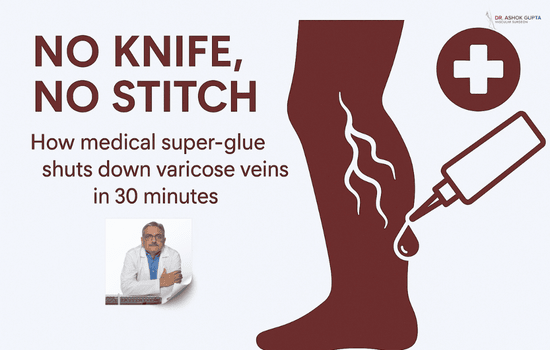
No Knife, No Stitch: How medical super-glue shuts down varicose veins in 30 minutes?

Varicose veins, those twisted, bulging blue cords that often appear on our legs, are more than a cosmetic concern. They can lead to discomfort, aching, throbbing, and in some cases, more serious health issues.
Modern medical science has introduced a new era of effective and convenient minimally invasive treatments, moving beyond traditional surgical options like vein stripping. Dr Ashok Gupta is at the forefront of this revolution, offering the advanced superglue procedure.
This groundbreaking solution uses medical-grade superglue to permanently treat varicose veins without incisions, stitches, or downtime. This innovative approach changes lives, providing a quick, painless path to healthier, better-looking legs.
What is super-glue?
A significant leap forward from older techniques, medical-grade superglue is a treatment for varicose veins that redefines modern care. Unlike heat-based treatments such as Endovenous Laser Ablation (EVLA) or Radiofrequency Ablation (RFA), superglue does not use thermal energy. It is a non-thermal method.
Instead, it utilises a specially formulated medical adhesive, cyanoacrylate, to physically and permanently close the diseased vein. This adhesive acts as a “sealant,” causing the vein walls to stick together.
With the vein sealed, blood flow is naturally diverted to the other healthy veins in the leg. Over time, the treated vein hardens and is gradually absorbed by the body, fading from view.
This no-heat, no-pain approach makes the superglue procedure one of the least invasive and most patient-friendly technologies available today.
The superglue procedure: A step-by-step guide
One of the most appealing aspects of superglue is its simplicity and speed. The entire process is a streamlined, outpatient procedure that can be completed in as little as 30 minutes, allowing you to return to your life almost immediately.
Here is a look at the medical-grade superglue 5 step procedure details:
- Evaluation and mapping: The process begins with a comprehensive consultation and a detailed duplex ultrasound examination. This allows us to accurately map the problematic veins and determine the best course of treatment for your specific condition.
- Local anaesthetic: To ensure your comfort, a small amount of local anaesthetic is administered to numb the single insertion site.
- Catheter insertion: Using ultrasound guidance, a tiny catheter is carefully inserted into the diseased vein through a small puncture in the skin.
- Adhesive deployment: Once the catheter is in the correct position, the medical adhesive is injected in small, controlled amounts. As the glue is deployed, gentle external pressure is applied to the vein to ensure the walls stick together and seal shut.
- Immediate mobilisation: The entire procedure takes place with you awake and comfortable. There is no need for sedation, and as soon as the procedure is finished, you can get up and walk out of the clinic without a hospital stay.
6 Key advantages of superglue
Superglue has quickly become a preferred choice for both doctors and patients due to its many significant benefits:
- Painless and bruise-free: The heat-free nature of the procedure eliminates the risk of skin burns or nerve damage, which can occur with thermal ablation methods. This results in minimal pain during and after the procedure, along with no post-operative bruising.
- No tumescent anaesthesia: Unlike other treatments that require multiple injections of a large volume of tumescent anaesthesia to protect surrounding tissue, superglue only requires a single injection of local anaesthetic. This further enhances patient comfort and simplifies the procedure.
- Freedom from compression stockings: Superglue often doesn’t require the use of compression stockings after the procedure. This is a significant relief for patients who find compression garments uncomfortable and restrictive, especially in warmer climates.
- Rapid recovery: Most patients can return to work, exercise, and their daily routine immediately after the treatment.
- Superglue high success rates: Superglue boasts high success rates. Clinical studies have demonstrated a closure rate of 98.9 % at one year and 94.6 % at five years, proving its effectiveness as a long-term solution.
- Superior aesthetics: With only a single, tiny puncture, there are no cuts, stitches, or scarring, providing exceptional cosmetic results.
What is better, Superglue Vs Laser?
Superglue and Laser (EVLA) are highly effective and minimally invasive treatments for varicose veins. The “better” option often depends on the patient’s circumstances and preferences.
Superglue offers a quicker, pain-free procedure with no bruising and no need for compression stockings, making it ideal for those who want a rapid return to daily life.
Laser (EVLA) is a heat-based procedure that requires tumescent anaesthesia and often mandates wearing compression stockings afterward. However, it has a long history of proven effectiveness and can be a more cost-effective option.
Looking for the best doctor for varicose vein treatment in your area?
Ultimately, the best way to determine the most suitable treatment is to consult a qualified vein specialist. Dr Ashok Gupta, a trusted vascular surgeon in Dubai, brings more than 30 years of exceptional experience to his practice.
He is a recognised specialist in treating lower limb veins and other vascular conditions and is known for his commitment to patient wellness and compassionate care. Dr Ashok Gupta offers advanced procedures and will help you choose the best path to healthier legs.
Dr Ashok Gupta and his team of experts are dedicated to providing you with a personalised and effective treatment plan.
Schedule a consultation to discover if the superglue procedure is the right solution for you. Take the first step toward getting healthier, more beautiful legs.
FAQ'S
Superglue is not considered a “surgery” in the traditional sense, as it is a minimally invasive procedure that doesn’t involve a knife, stitches, or general anaesthesia.
It is an outpatient treatment that uses a medical-grade adhesive to seal varicose veins, with a much quicker recovery time and fewer post-procedural restrictions than conventional surgery.
While superglue is highly effective, there are a few considerations. The most notable is the cost. It can be more expensive than other treatments like laser or radiofrequency ablation. There is also a minimal risk of an allergic reaction to the adhesive, although this is rare.
For these reasons, it is crucial to have a qualified and experienced vein specialist perform the procedure. They can properly assess your needs and discuss all potential risks.
The results from the superglue procedure are designed to be permanent. Clinical studies have shown very high success rates in vein closure, with studies reporting a 94.6 % closure rate at five years.
The treated vein is sealed shut and eventually absorbed by the body. Once sealed, the vein is permanently closed and will not become varicose again. While effective, superglue does not stop the development of new varicose veins in different areas of the legs.
Recent Blogs


Quick Enquiry